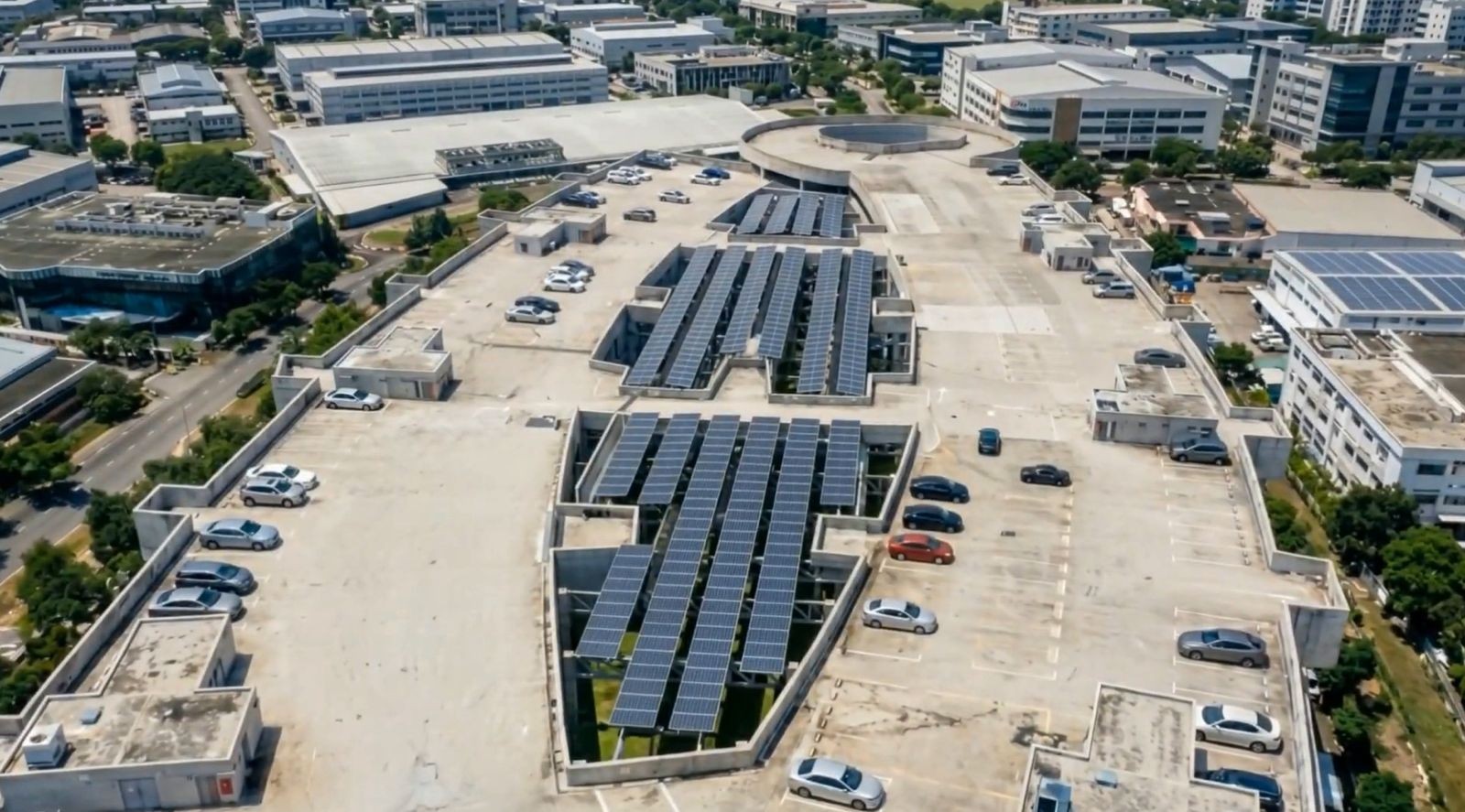
JTC is piloting new ways to harness solar energy from unconventional spaces in its industrial estates. It has awarded Singapore’s first solar project at 15 Woodlands Loop, where solar panels are suspended across the void between two existing buildings (overhang). It has also launched two innovation calls seeking industry solutions to deploy solar on building façades and at construction worksites with limited access to the national grid.
With conventional spaces such as rooftops and open land becoming increasingly limited, these efforts open up new spaces for solar as Singapore works towards its target of 3 gigawatt-peak of installed solar capacity by 2030.
JTC has awarded the tender for Singapore’s first overhang solar project to global renewable energy company EDP APAC. EDP will design, build, operate and test the overhang solar structure over 15 months from October 2026, targeting at least 250 kWp of installed capacity across an estimated void space of 4,300m². Once commissioned, the system will operate for 10 years, exporting the electricity to the national grid.
Installing such structures comes with unique engineering and operational challenges. The overhang structure must safely carry its own weight and that of the panels and withstand wind forces at height. Building spacing must be studied to maximise sun exposure without compromising the structural integrity, ventilation or fire safety of the existing buildings. Safe access for installation and maintenance works at height, and proper drainage to prevent water from pooling on the structure, are also critical considerations.
JTC’s first innovation call invites companies to propose solar solutions that can be installed directly onto industrial façades. Industrial buildings have large façades that remain untapped for solar installation. Unlike rooftops, façades differ in design, orientation and how much weight they can bear. Solutions must be light enough to install without major reinforcement works and connect seamlessly to the building's existing electrical systems. The selected solution will be installed on at least 200 m² of façade at JTC’s YS-ONE industrial building in Yishun and tested over 12 months.
JTC's second innovation call seeks off-grid, portable systems that pair containerised solar panels with mobile battery energy storage systems. Many temporary construction worksites and remote locations have little or no access to the national grid and rely heavily on diesel generators. These systems can be commissioned within days and redeployed across different sites as needed. They could be used to power site offices, electric construction equipment, EV charging. JTC will measure how much time, cost and carbon emissions the selected solution will save compared to diesel generators over a nine-month trial.
Insights from both calls will help JTC assess whether these solutions can be rolled out more widely across Singapore’s industrial developments.
Finn Tay, JTC’s Chief Sustainability Officer, said, “Every surface is a potential power source. By testing solar in the spaces between, on and beyond our buildings, we are finding new ways to grow Singapore’s solar capacity.”
These initiatives build on JTC's SolarLand and SolarRoof programmes, introduced in 2017 to harness temporary vacant land and industrial rooftops for solar. The programmes have deployed 1,051 MWp to date, including Singapore's largest ground-mounted installation of 118 MWp on Jurong Island. This accounts for 45% of Singapore’s installed solar capacity of 2,339 MWp and is sufficient to power over 245,000 4-room HDB flats and cut carbon emissions by more than 450,000 tonnes a year.