New pilot expands JTC’s SolarLand and SolarRoof programmes to unlock more space for solar deployment across industrial estates in Singapore
*As announced in MTI's Committee of Supply Debate in Mar 2026 , Singapore's solar target has been raised to 3 GWp by 2030.
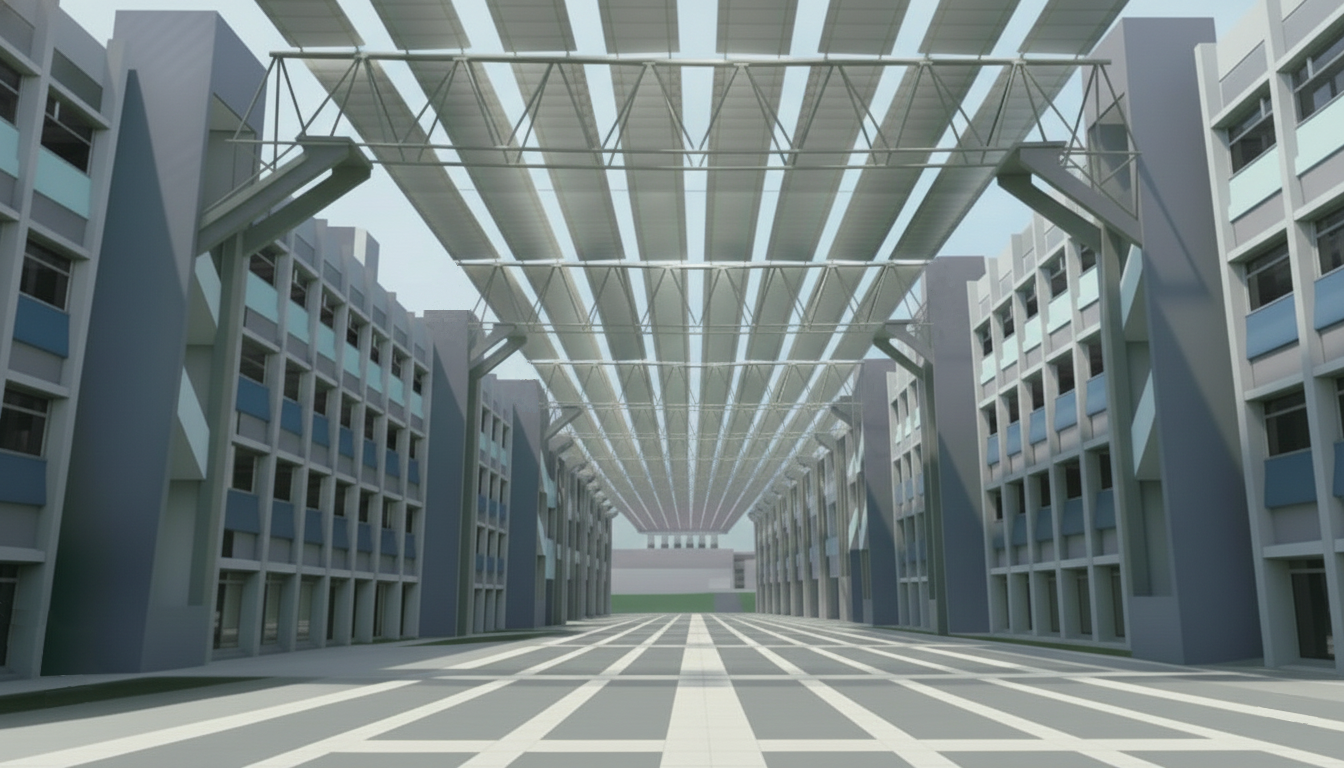
JTC launched a tender to develop Singapore’s first overhang solar photovoltaic (PV) system at 15 Woodlands Loop, marking a new approach in optimising solar deployment in Singapore’s industrial estates. The pilot project tests the viability of PV systems on overhang structures constructed across void spaces between multi-storey industrial buildings, to serve as an alternative to conventional land-based or rooftop installations.
Solar energy remains Singapore’s most viable renewable energy source. As of the second half of 2025, 1,775.4 MWp1 of PV systems have been deployed nationwide, which is more than half of Singapore’s 2 GWp solar target by 2030*. However, most PV installations today are located on rooftops, vacant land, or water bodies, which are expected to reach physical saturation.
To continue expanding solar energy production, Singapore must increasingly co-locate solar with existing infrastructure. This pilot is part of JTC’s broader push to maximise untapped spaces within industrial estates and support national solar targets.
Building overhang PV systems between existing buildings comes with several unique engineering and operational considerations. These include ensuring the structures can safely carry the additional weight and withstand wind resistance given the elevated installation height. Optimal spacing between buildings must be studied to maximise solar exposure while maintaining the structural integrity, ventilation and fire safety requirements of the existing buildings. Safe access provisions for installation and maintenance works at height, as well as drainage management to prevent water accumulation on the overhang structure, are also critical. These learnings help determine how such systems can be developed and deployed at scale.
The first stage of the project involves the design, construction, operation, and testing of the overhang solar structure over a 15-month period. As a novel PV system, this phase is a process to uncover and address the constraints that may arise when installing the overhang solar PV system between buildings. A key success indicator for the pilot is to achieve a minimum installation capacity of 250 kWp across the identified void space of about 4,300 m² between the buildings. Upon successful installation and commissioning, the project will then be operational for a 10-year period, where generated electricity will be exported to the national grid.
JTC will also study the potential to replicate and scale the deployment of similar overhang PV systems across other industrial estates, drawing on insights and findings from the pilot. Such deployment unlocks additional solar capacity across JTC estates and opens opportunities for scaling to other multi-storey buildings in Singapore.
The pilot extends JTC’s SolarLand and SolarRoof programmes, introduced in 2017 to harness temporary vacant land and industrial rooftops for solar generation. As of the first quarter of 2025 , JTC has deployed 875 MWp of solar capacity across its estates, including the latest PV deployment of 118 MWp on Jurong Island as Singapore’s largest ground-mounted solar deployment. This is equivalent to powering over 204,000 units of 4-room HDB flats annually and achieving 70% of JTC’s 1,250 MWp solar target by 2030. The current progress also contributes toward Singapore’s national goal of deploying at least 2 GWp of solar energy by 2030.
Finn Tay, Chief Sustainability Officer, JTC said, “As a land-scarce nation, Singapore must continually find creative ways to optimise our industrial spaces. Solar energy remains a key renewable energy source for powering our estates, and we are pushing ourselves to look beyond conventional rooftops and ground-mounted systems. This pilot is one example of how we are rethinking underused spaces to unlock new solar potential and support Singapore’s long-term energy goals.”