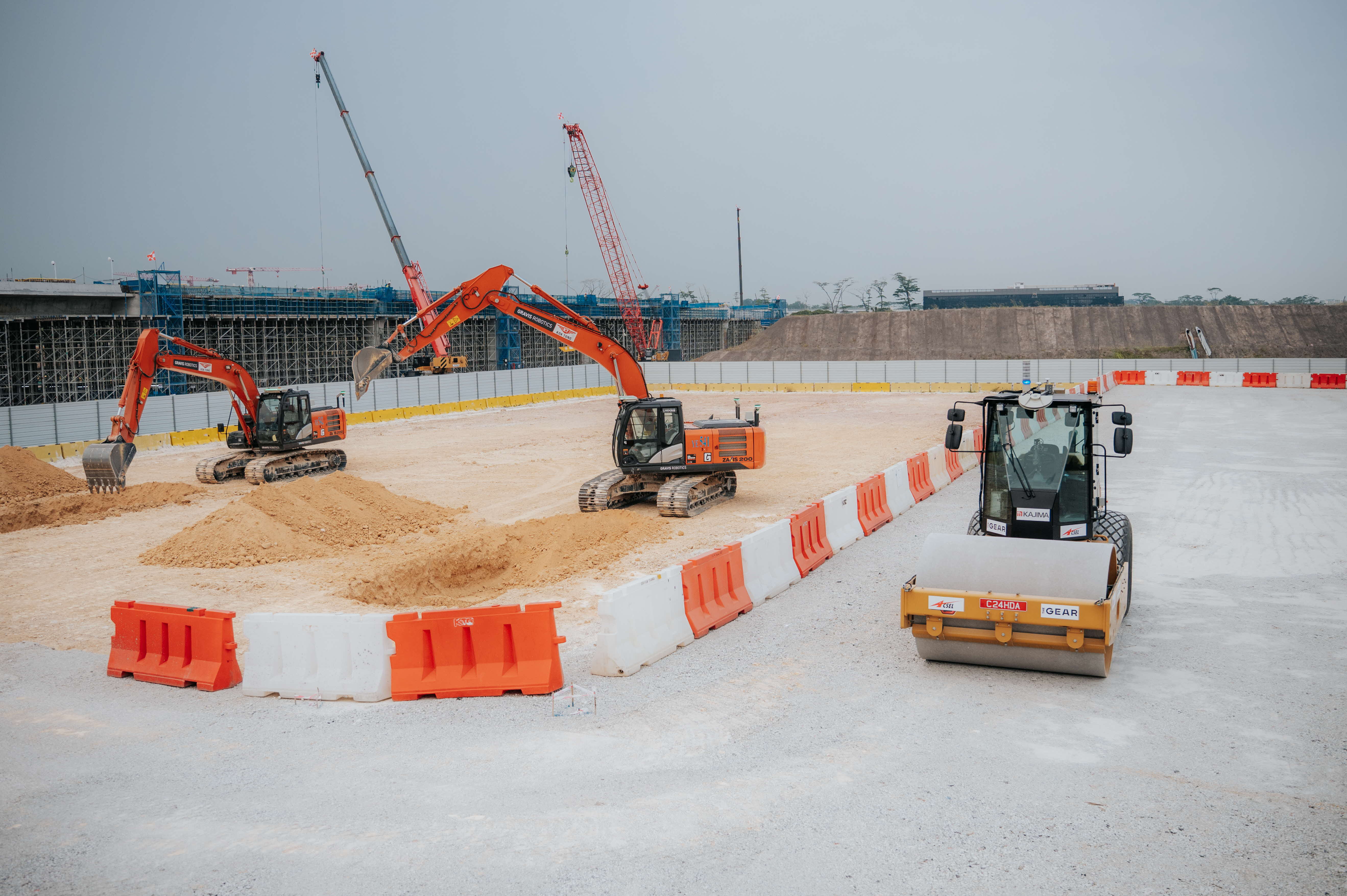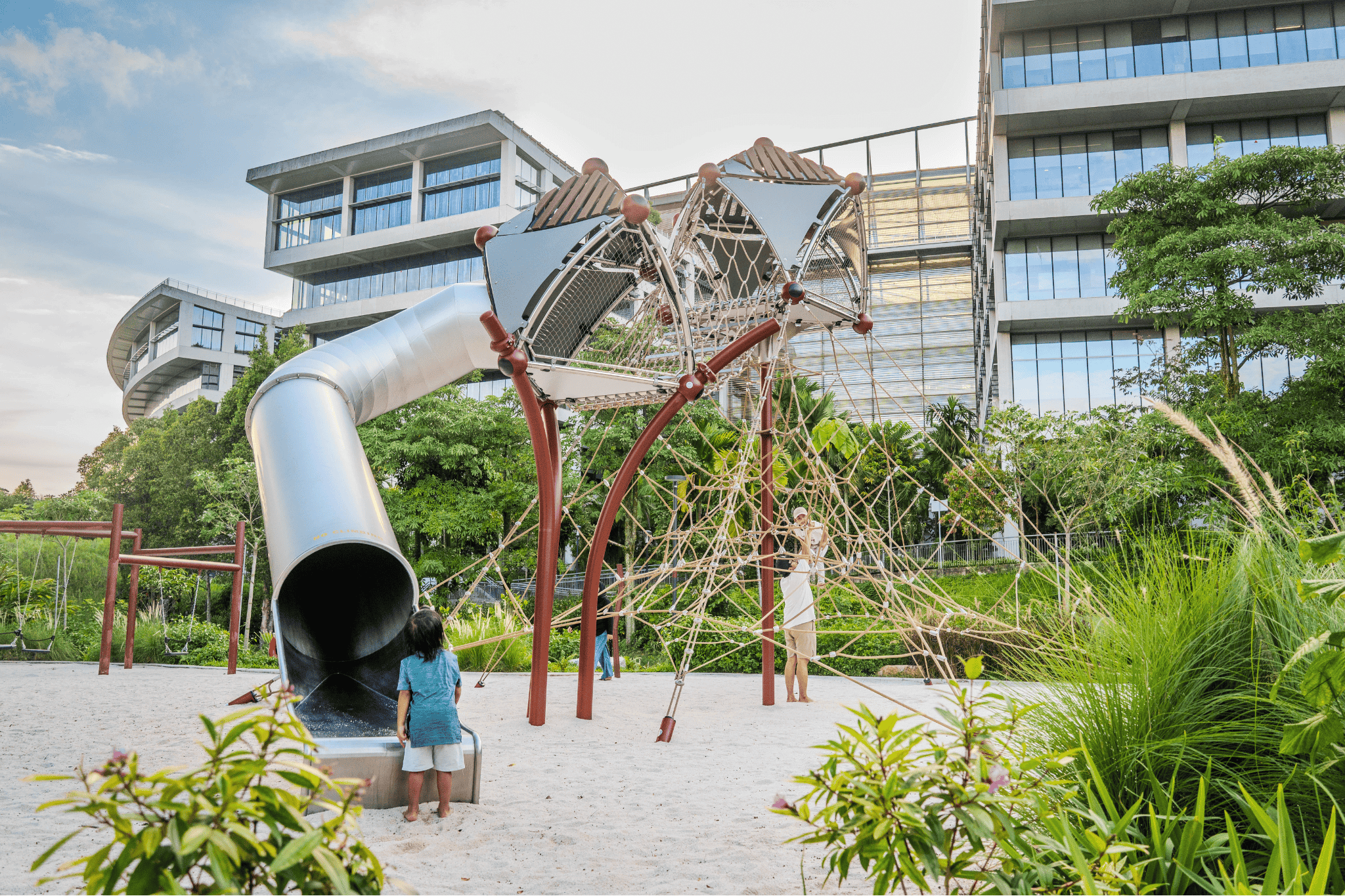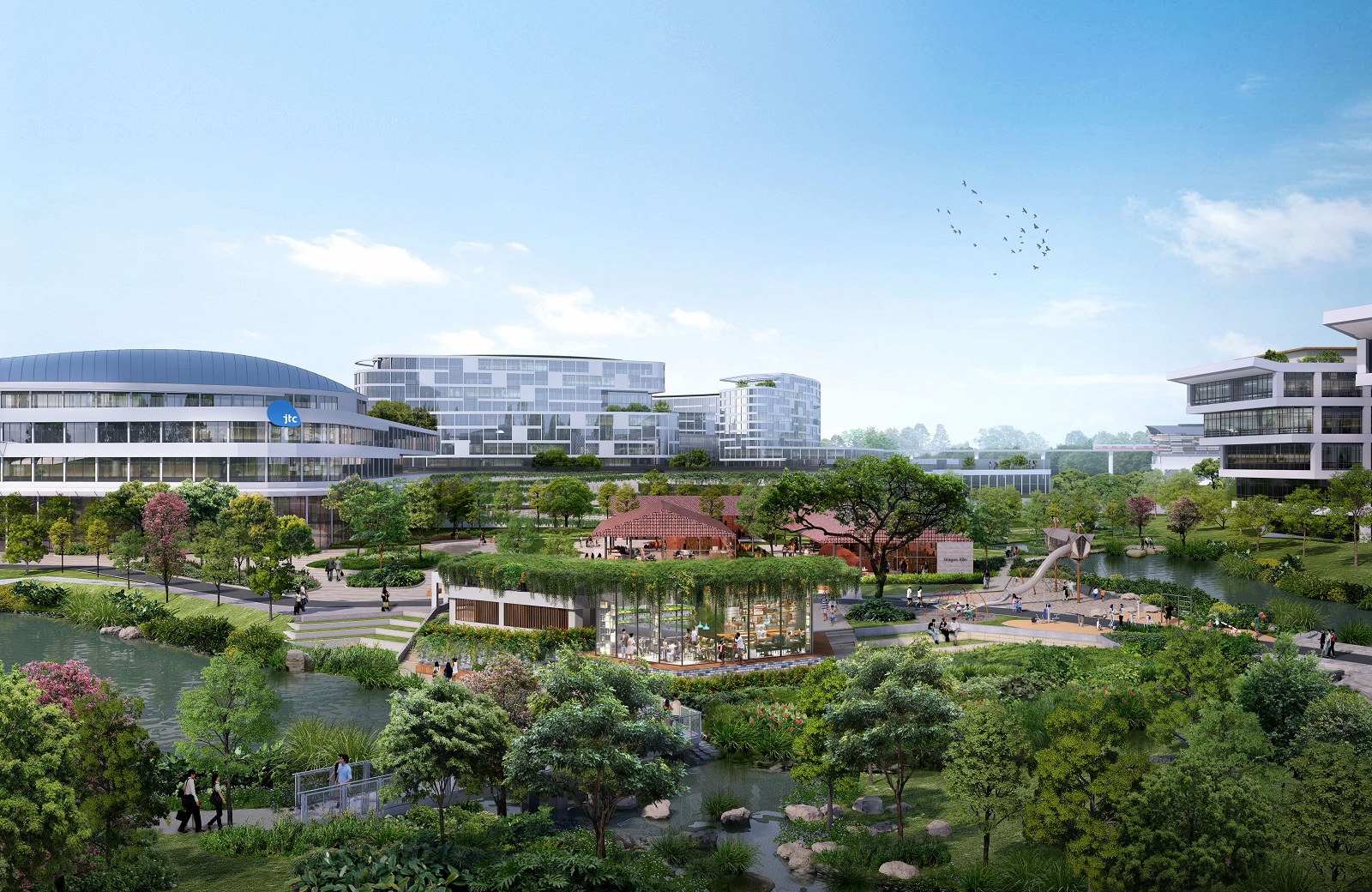
JTC seeks to build Industry in Nature. This is our commitment to creating sustainable and smart industrial ecosystems that help to drive Singapore’s growth while integrating nature and biodiversity in enriching the places where people work, live, play and learn.
This concept is being applied to Jurong Innovation District (JID), a 620ha next-generation industrial district which aims to create 95,000 jobs while driving economic growth. Developed in phases as an advanced manufacturing hub, JID comprises five precincts — Nanyang Technological University (NTU), CleanTech Park, Bulim, Bahar and Tengah. The five-precincts project will bring together expertise from research, capability developers, manufacturers and community spaces into one integrated ecosystem.
CleanTech Park is Singapore's first eco-business park and forms one of the anchor precincts in JID to support the clean technology sector by encompassing the full advanced manufacturing value chain from research and capability developers to solution providers, institutes of higher learning, and training facilities, providing a platform for testing and advancing sustainable solutions.
Bulim Square provides sustainable factory spaces for companies supporting key sectors like semiconductor, aerospace, automation, healthcare and robotics. Bulim precinct was awarded BCA’s Green Mark Platinum for Districts, the first heavy industrial district in Singapore to achieve this sustainability certification.
Bahar is the next precinct planned for development, to strengthen the advanced manufacturing ecosystem in JID.
Land preparation and infrastructure works are being planned for future industrial development in CleanTech Park and Bahar. These works will include essential infrastructure such as roads, drains, sewers and utilities. They will also support the opening of Jurong Region Line JW2 MRT Station. These infrastructure works typically take around six to eight years from planning to completion.
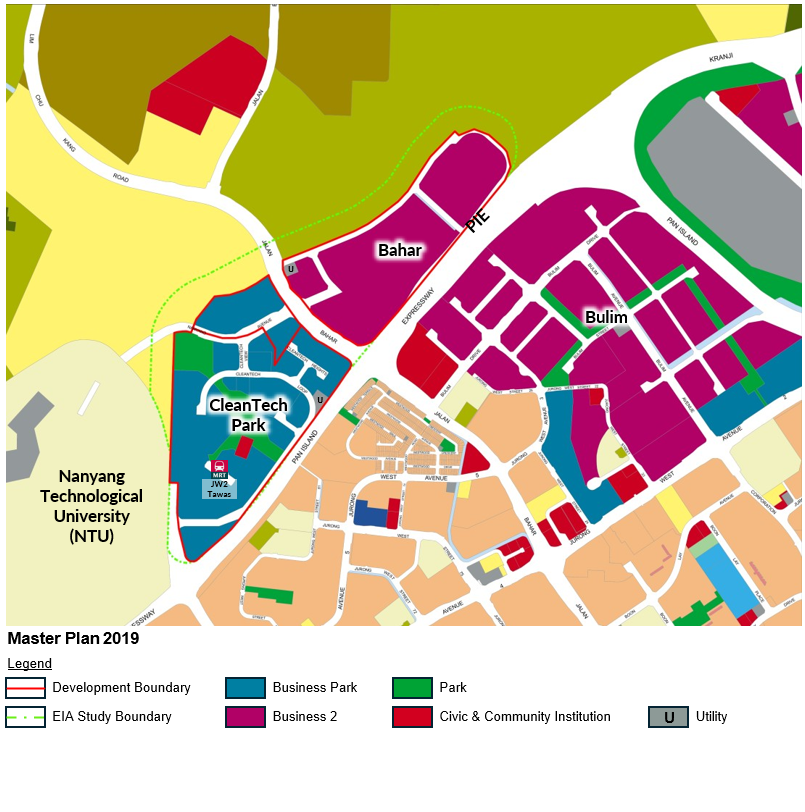
The 116ha project site, covering both CleanTech Park and Bahar, is located along Jalan Bahar, near the Pan-Island Expressway (PIE) intersection. Under the Draft Master Plan 2025, the project site is zoned for Business Park and Business 2 uses.
As part of the planning process for the future development of CleanTech Park and Bahar, JTC carried out an Environmental Impact Assessment (EIA) as the developments are near sensitive nature areas. The EIA assessed the potential environmental impacts of the proposed works and recommended the appropriate mitigation measures to minimise any impacts. We also consulted nature groups on the biodiversity in the area and have taken their feedback into account when reviewing the EIA report.
The EIA has identified areas within CleanTech Park and Bahar supporting fauna and flora of conservation significance, notably fauna such as the harlequin butterfly (Taxila haquinus hacuinus), variable featherlegs (Copera vitata), bamboo bats (Tylonycteris sp.), and non-synchronous bent-winged firefly (Pteroptyx valida), as well as plant species such as the fig tree Ficus stricta and orchid Nervilia singaporensis. We will therefore study the retention of areas supporting these species alongside the development of industrial spaces.
JTC believes that these retained areas can complement existing green spaces in JID, such as The Potter's Garden. We recently rejuvenated The Potter’s Garden to mimic the natural structure of forests as far as possible, recreating habitats for birds, butterflies, dragonflies, and other species to thrive. The Potter’s Garden incorporates and is named after two pottery kilns which are important parts of Singapore’s heritage — Jalan Bahar Clay Studios and Thow Kwang Pottery Jungle. Together, the green spaces serve as habitats and connections for wildlife amidst the industrial estate.
We will also develop and implement comprehensive mitigation measures to minimise environmental impact in the area. Specifically:
1. Flora: Environmental conservation measures will be implemented in tandem with the plans for future industrial development. Prior to land clearance, plant saplings of native threatened species that are assessed to be suitable for transplanting will be salvaged from the site. We will evaluate the feasibility of infill planting, which involves adding native plants and selectively removing undesirable exotic species to strengthen the existing forest and minimise the likelihood of decline in health and survival rates of current vegetation.
2. Fauna: Site clearance will be carried out in phases to facilitate wildlife movement to adjacent plots of green spaces. During construction, inspections will be conducted with a trained ecologist to check for the presence of wildlife before trees are felled. If active bird nests are found on trees marked for felling, we will ensure that the nests will not be affected unless they are no longer occupied. Wildlife specialists will be engaged to translocate any wildlife found to be trapped within the site during construction.
3. Earth Control: Proper Earth Control Measures (ECM), such as fully biodegradable erosion control blankets made of natural fibre will be used to cover exposed surfaces. These measures will help to prevent soil erosion and runoff during heavy rain, minimising the risk of silt accumulation in drains and canals. This will ensure that nearby waterways are kept clean and free from any potential obstruction. The erosion control blankets will also be checked regularly during land clearance to avoid trapping ground-dwelling wildlife such as snakes and lizards.
The EIA is currently available online for public viewing and feedback at https://www.jtc.gov.sg/about-jtc/championing-sustainability/environmental-studies from 1 December 2025 to 28 December 2025.
JTC will carefully review the findings and recommended mitigation measures in the EIA report, as well as the feedback received during the public disclosure period, before finalising the EIA report, mitigation measures to be undertaken, and the extent of development works for this site. Non-invasive site preparation, such as soil investigation and surveys, are planned to commence in 1Q2026. All construction works for CleanTech Park and Bahar will only proceed after both the EIA report and development plans are finalised. This is to ensure all environmental considerations and planning requirements are comprehensively addressed before the commencement of works.