JTC Corporation (JTC) and Kajima Corporation (Kajima), Japan’s leading construction company, have launched the first pilot project to explore the use of autonomous heavy construction equipment in Singapore.
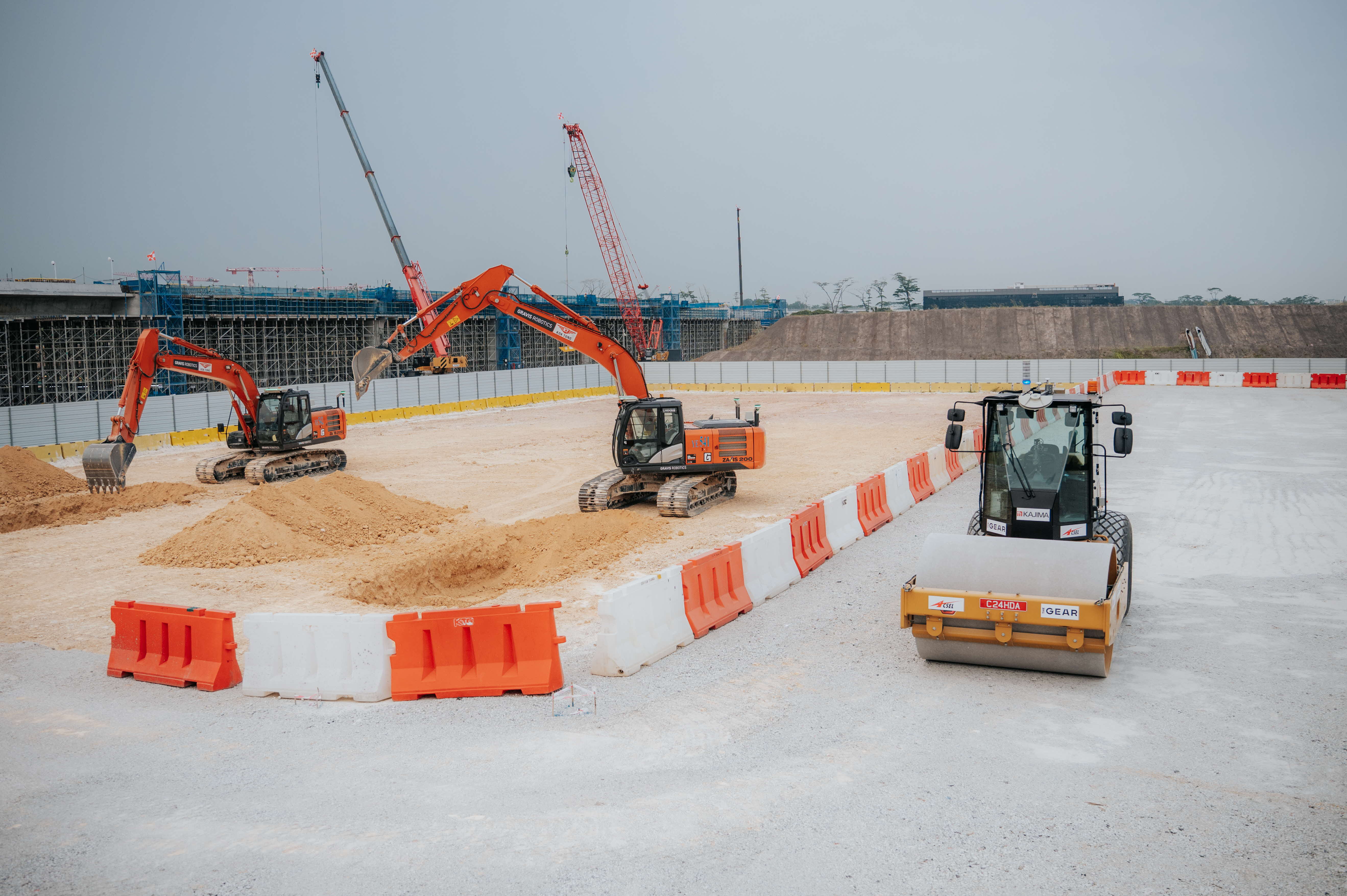
Held at Jurong Innovation District, these autonomous machines, starting with excavators and compactors, will be tested at the Bulim Autonomous Yard (BAY), JTC’s sandbox for validating autonomous construction equipment under real site conditions. Together with the Public Sector Science & Technology Policy & Plans Office (S&TPPO) and the Housing & Development Board (HDB), this pilot will test how these machines can ease Singapore’s construction manpower constraints and improve safety.
Building faster: Raising productivity with fewer workers
Since 2025, JTC has been mandating the use of robotics in construction tenders to achieve higher productivity in the sector.
Under the trial, an operator assigns tasks and sets virtual geographic boundaries (geofencing) for each autonomous construction machine. Using sensors and artificial intelligence, the machine then carry out the tasks independently, without an operator in the cabin or elsewhere. The activities are monitored remotely by staff who will intervene whenever an issue occurs. JTC is targeting a reduction of operator manpower by half, with one operator overseeing two machines.
The pilot will draw on technologies from multiple technology partners. To automate digging, the excavator uses a retrofit kit from Gravis Robotics1, a Zurich-based startup that develops autonomous software and hardware for earthmoving equipment. Similarly, the compactor runs on Kajima's A4CSEL2, its first deployment outside Japan. Retrofitting is an important design feature that lowers the barrier to adoption, as contractors can upgrade machines they already own, rather than replace entire fleets.
Mr Calvin Chung, Assistant Chief Executive Officer, Engineering & Operations Group, JTC, said: “Adding more manpower is not a sustainable way to meet Singapore’s future construction needs. JTC has a pipeline of at least 800 hectares of earthworks projects over the next five years. If the pilot succeeds, we will deploy autonomous heavy construction equipment across suitable projects in our pipeline and support wider industry adoption.”
Building safer: Keeping workers away from hazardous zones
Autonomous construction equipment has the added advantage of reducing workers’ exposure to some onsite safety hazards by decreasing the need for personnel to operate machinery or work in close proximity to moving equipment.
Arising from the BAY trials, JTC is working with Ministry of Manpower (MOM) to develop operating guidelines and safeguards to support industry-wide deployment while prioritising human safety. These include geofencing to keep machines within designated areas, LiDAR sensors to detect humans and obstacles, and emergency-stop controls on site and in the control room.
Building smarter: Scaling from individual machines to coordinated autonomous fleets
JTC and Kajima will also explore extending the trial to autonomous bulldozers and dump trucks in 2027, creating a coordinated fleet of machines.
Mr Yoshihiko Riho, Senior Executive Officer, Kajima Corporation, said: “Through close collaboration with JTC and our local partners, we will advance the development of automated construction technologies that enhance productivity, safety and quality, while addressing the challenges facing Singapore's construction industry. We believe the combination of Kajima's technologies and Singapore's innovation-driven environment will help realise the next generation of construction.”
Scaling autonomous construction will require new skills in data interpretation, digital task planning, system integration and maintenance. As these capabilities are nascent in Singapore, Kajima is working with local contractor Kok Tong Construction and equipment provider Tractors Singapore Limited to retrofit conventional equipment with autonomous capabilities, train Singapore-based operators and engineers, and document lessons from the pilot for wider industry adoption.
Beyond the pilot, JTC will be collaborating with public agencies, contractors, equipment providers, research institutions, and technology companies to conduct more autonomous construction trials at the BAY sandbox.
1 Gravis closed their Series A in August 2026 with a $200 million investment from SoftBank. As the largest Series A in construction robotics history, this funding enables Gravis to scale autonomous heavy machinery across jobsites globally.
2 A4CSEL has been used across a range of civil engineering projects in Japan. During the construction of Naruse Dam in Akita Prefecture, A4CSEL enabled three operators based 400km away to manage 14 automated dump trucks, bulldozers, and vibratory rollers, with the machines running continuously for up to 70 hours at one point.