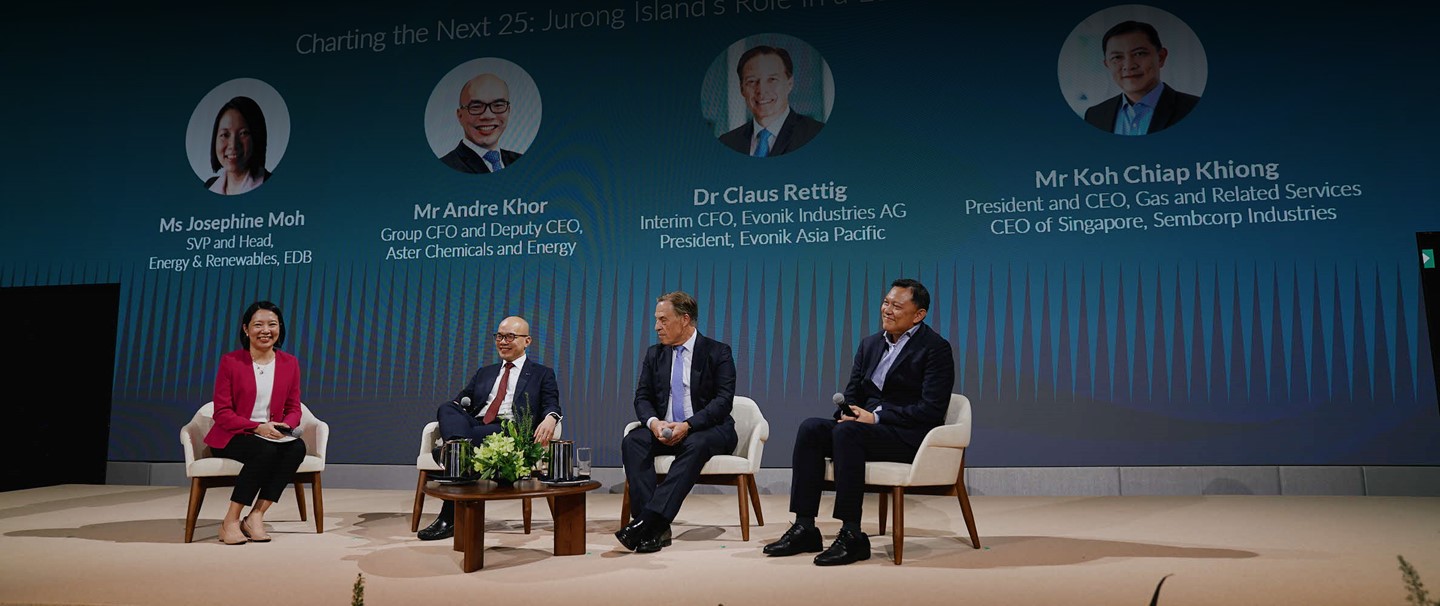

A "kampong spirit" for the industry
There's a phrase that surfaces often in conversations about what makes Jurong Island work: "kampong spirit".
It's an unusual description for one of the world's most sophisticated petrochemical complexes, home to over 100 global energy and chemicals companies connected by more than 100 kilometres of pipelines.
Yet according to Koh Chiap Khiong, president and CEO of Sembcorp's Gas and Related Services, this village mentality defined the island from its earliest days: "The camaraderie was really a 'kampong' spirit. Customers, off-takers, utilities players, all working as a community".
That community mindset represents more than sentiment. It’s the strategic architecture that has allowed Jurong Island to continuously adapt over multiple decades. As global energy and chemicals markets undergo fundamental transformation, driven by decarbonisation imperatives, digitisation, and shifting demand toward specialty products, this collaborative DNA may be the island’s most valuable asset for the decades ahead.

The ecosystem advantage
Dr Claus Rettig has been part of chemical plant projects around the world. As interim CFO of Evonik and president of Evonik Asia Pacific, he's seen Germany's chemical heartlands and Asia's emerging hubs. But Jurong Island stands apart for a specific reason: "From 2008 until today, all our projects on Jurong Island have always been on time, always on budget".
What creates such consistency? Rettig points beyond individual facilities to the larger ecosystem. "If you view the ecosystem as only Jurong Island, that's not good enough. The ecosystem includes EDB and JTC. Without the two, the island wouldn't have worked. And don't forget logistics support", he said.
This integrated thinking shaped Jurong Island from the beginning. Sembcorp's centralised utilities, comprising wastewater treatment, service corridors connecting pipelines and cables, created shared infrastructure that reduced costs and increased efficiency across companies. Rather than building redundant facilities, companies could connect to a common platform—an approach that now enables the island to function as a living laboratory where breakthrough technologies are tested and scaled within real-world industrial conditions.
Unlike isolated R&D centres, innovations here are piloted alongside ongoing commercial operations, creating unique advantages. For example, the vanadium battery storage system being developed by VFlowTech leverages Advario's existing storage tank infrastructure, demonstrating how emerging energy storage technologies integrate with established industrial assets whilst scaling from 1.6 MWh to 40 MWh. Similarly, IHI Corporation and A*STAR's sustainable aviation fuel production test rig operates as one of the world's largest bench-scale facilities, benefiting from access to CO₂ sources, hydrogen supply chains, and the operational expertise of companies already managing complex chemical processes.
Koh traces this approach back to foundational decisions: "When we first started in the late 90s, the concept of sustainability was actually at the system level", Koh explained. "Reusing the heat, reusing the water, optimising land use, shared facilities. That forms a very strong foundation for us to move to the next leg".

Building on strong foundations
That foundation now supports Jurong Island's transformation into a hub for specialty chemicals, sustainable materials, and low-carbon technologies. The developments attracting industry attention reveal how ecosystem thinking drives ongoing transformation.
Consider the convergence of industrial chemistry and digital infrastructure. The island's upcoming data centre park doubles up as a testbed to demonstrate ecosystem logic: traditional data centres operate in isolation, consuming enormous amounts of energy whilst generating waste heat that's typically dissipated. Jurong Island's integrated approach transforms these challenges into cross-sector opportunities. The data centre park will tap directly into the island's diverse energy sources—natural gas power plants, solar installations, and emerging hydrogen-ready facilities—whilst waste heat from AI and high-performance computing operations can be captured and redirected to support chemical processes that require thermal energy... Each sector's challenge becomes the other's opportunity.
This cross-sector synergy has always defined Jurong Island. Sembcorp's clean energy initiatives there, like its large-scale solar installation and battery stacking solution, boost renewable energy capacity and benefits multiple industries. Evonik's expansion into alkoxides for biodiesel and petrochemicals builds on existing infrastructure while opening new markets. Aster's partnerships on sustainable aviation fuel and low-carbon hydrogen production with Air Liquide connect energy security with decarbonisation goals.
The pattern remains consistent: companies investing in transformation while leveraging shared infrastructure and finding pathways to make sustainability commercially viable.
The affordability imperative
Yet transformation faces a hard constraint: cost. During recent industry discussions, this reality surfaced repeatedly. Affordable energy matters because even the most efficient process becomes unviable if energy costs price products out of the market.
Most operational costs on Jurong Island stem from imported fuel. As individual companies, there's limited room to manoeuvre. As a coordinated ecosystem, the possibilities expand. Koh frames the question directly: "As a whole community, can we actually do things differently? How do we work, win-win for all, to lower costs?"
He references foundational precedents. Sembcorp Utilities Terminal was established as a joint venture between JTC, EDB, and Sembcorp specifically to catalyse industry growth by building infrastructure at scale to reduce costs. That pioneering approach to collective problem-solving remains relevant as companies navigate the economics of decarbonisation.

Intangible infrastructure
Pipelines, crackers, and carbon capture systems dominate discussions about industrial infrastructure. Yet Jurong Island's most valuable asset is something you can't see on a site map: the relationships that make the entire system function.
For Andre Khor, Group CFO and deputy CEO, Aster Chemicals and Energy, what struck him most about joining Jurong Island's ecosystem through Aster's recent acquisitions. Technology or infrastructure ranked lower than the "passion and the grit and the perseverance of the people, the tripartite relationship" that Singapore has cultivated.
This social infrastructure – the trust between government agencies, industry players, and workers – enables companies such as Evonik to consistently deliver projects on time and on budget. It allows Sembcorp to coordinate centralised utilities that serve the entire island. It makes it possible for competitors to cooperate on shared challenges like energy costs and decarbonisation.
Rettig emphasises that even after 25 years on Jurong Island, Evonik continues to discover new opportunities for collaboration with companies like Aster. "We need to work closer together", he said.
In many industrial clusters around the world, companies operate in parallel, competing for resources and working around each other's constraints. On Jurong Island, they've learned to operate in concert, treating each other's challenges as shared problems requiring collective solutions. That intangible infrastructure has proven hardest to replicate and most valuable to preserve.

Lessons for the future
Building systems that function efficiently at scale through sustained collaboration – this principle has defined Jurong Island's development and remains central to its transformation. Industry leaders consistently return to this theme: the importance of working together across agencies and companies, ensuring integrated systems continue their effectiveness, and making incremental improvements that compound over time.
The global transition to low-carbon economies is reshaping industrial geography. Traditional petrochemical hubs face decisions about whether to defend legacy positions or transform into new configurations. The technical challenges are substantial: decarbonising energy-intensive processes, developing sustainable feedstocks, integrating renewable energy at industrial scale.
Jurong Island's experience suggests that technical innovation alone won't determine which hubs successfully navigate this transition. The infrastructure that matters most combines physical assets with digital capabilities and social capital. The ability to coordinate across companies, sectors, research institutes, and government agencies. The willingness to share both costs and benefits of transformation. The trust required to make long-term investments in uncertain technologies.
As A*STAR prepares to open its S$62.5 million Low Carbon Technology Translational Testbed (LCT³) in 2027, the facility will embody this integrated approach. Companies will be able to test emerging technologies—from carbon capture and utilisation to advanced hydrogen production—within a modular, plug-and-play environment that connects directly to Jurong Island's industrial ecosystem.
Industrial ecosystems worldwide are watching how established hubs adapt. Some will try to preserve existing advantages. Others will attempt wholesale reinvention. Jurong Island demonstrates a third path: leveraging the collaborative capabilities that created initial success to enable continuous transformation.
The kampong spirit that built this island remains its most enduring competitive advantage, and perhaps its most instructive lesson for industrial development in a decarbonising world.