
As global energy supply chains face mounting uncertainty, the questions facing Singapore's infrastructure are as much about what lies beneath the ground as what stands above it. Jurong Rock Caverns — Southeast Asia's first commercial underground liquid hydrocarbon storage facility — was built decades ahead of the disruption now reshaping global trade. The engineers behind it explain how a bold idea, decades in the making, is quietly underpinning Singapore's role in global energy resilience.
On the surface, Jurong Island looks much like any sophisticated industrial complex: refineries, chemical plants, pipelines, and terminals connected across more than 3,000 hectares. What visitors cannot see is what makes it extraordinary – five vast caverns hewn from solid rock, 130 metres beneath the seabed, capable of holding the equivalent of 9 million barrels of liquid hydrocarbons.
"Jurong Rock Caverns embodies Singapore's long-term strategy: planning ahead, optimising scarce resources, and creating an environment where industries can thrive", says Brian, Director of the Infrastructure Projects Division.
What exactly is Jurong Rock Caverns?
Jurong Rock Caverns is Singapore's deepest known underground public works project to date and the first commercial underground rock cavern facility in Southeast Asia. Completed in 2017 after more than fifteen years of planning and construction, it comprises five caverns — four large chambers each holding 330,000 cubic metres of product, and one smaller cavern holding 150,000 cubic metres — for a combined storage capacity of 1.47 million cubic metres of liquid hydrocarbons, including crude oil, condensate, gas oil, and naphtha.
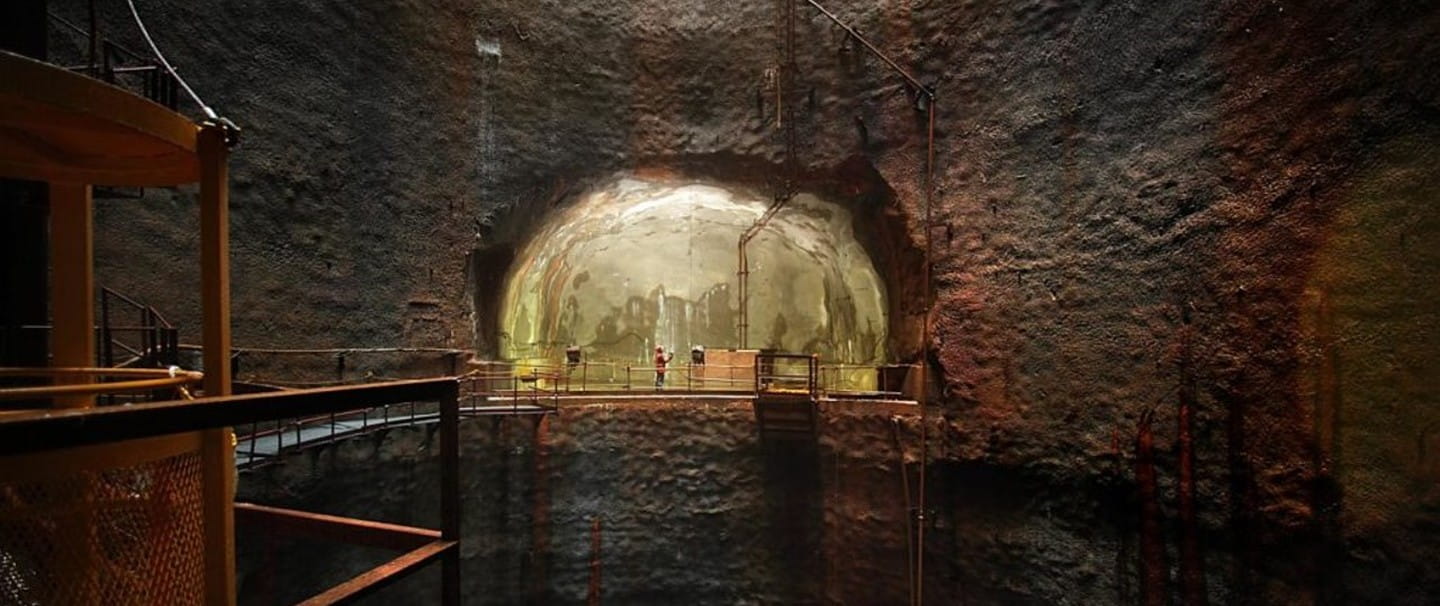
Each cavern stands approximately 27 metres high, comparable to a nine-storey building. Over 3.5 million cubic metres of rock were removed and nine kilometres of tunnels carved beneath the Banyan Basin to create the chambers and their connecting tunnels.
"It is about nine storeys high – a bare rock cave, with water seepage constantly permeating through the cracks. There is nothing quite like it", says Alan Ling, Principal Project Manager, JTC Infrastructure Projects Division.
How was Jurong Rock Caverns built?
Development of Jurong Rock Caverns began in 2001, with six years dedicated to conceptual planning, feasibility studies, and soil investigations before a single tonne of rock was moved. Construction began in 2007. The first two caverns became operational in 2014; the final three were completed in 2017.
One of the central engineering challenges was the rock itself. Unlike the granite typical of major tunnelling projects, the rock beneath Jurong Island is sedimentary – layered, with natural, irregular cracks through which water seeps.

"Managing water flowing through these cracks as we continued our works was one of our core challenges", explains Alan, who oversees the facility's day-to-day operations. The solution was grouting: pumping a water-cement mixture into the rock to seal fissures and reduce water ingress.
Because the caverns sit beneath the seabed, traditional soil investigation methods were not viable. Instead, the project team deployed horizontal directional coring, a technique new to Singapore at the time, to assess rock conditions from a distance. Each cavern was then excavated in three nine-metres stages, top-down, allowing engineers to study the rock as they descended and refine their methods in real time.
How does underground hydrocarbon storage work safely?
The principle behind Jurong Rock Caverns’ design is elegantly simple: water pressure does the work.
By positioning the storage caverns below sea level, engineers harness the natural hydrostatic pressure of the surrounding groundwater to contain the stored hydrocarbons. Water exerts constant positive pressure on the cavern walls, preventing any oil from escaping into the surrounding rock or sea. Water that seeps into the caverns; this is by design; sinks to the base while oil floats to the top. The water is continuously pumped out and treated.

"For aboveground storage, corrosion is a constant risk. Underground, the rock and the natural water pressure do the job instead", Alan explains.
A central control room monitors inventory in real time, with dedicated shift teams operating around the clock.
Why did Singapore build underground?
The decision was not driven by any single crisis. It was the product of decades of deliberate planning in the face of a constraint that has shaped every aspect of Singapore's development: land scarcity. With a total land area of just 716 square kilometres, Singapore has had to think creatively about how every hectare is used.
Jurong Island hosts more than 100 energy and chemicals companies whose operations require large quantities of liquid feedstock. Traditionally, that feedstock was stored in large aboveground tanks occupying substantial areas of prime industrial land. By relocating storage to 130 metres below the seabed, Jurong Rock Caverns freed approximately 60 hectares of surface land, the equivalent of 70 football fields, for higher-value activities such as chemical manufacturing, R&D, and emerging clean energy industries.
"What seemed impossible is achievable when there is long-term vision, strong technical capability, and the will to innovate," Brian says. "Jurong Rock Caverns has put Singapore on the map as a leader in underground space solutions."
What does Jurong Rock Caverns mean for Singapore's energy resilience?
Jurong Rock Caverns was not built as a crisis response; it was built as infrastructure. But its significance is sharpened by exactly the kind of global disruption that has characterised 2026: supply chain pressures, constrained shipping routes, and heightened demand for reliable partners in the energy trade.
Singapore is one of the world's top six refinery export hubs and a top-three global oil trading hub. Its refining capacity of approximately 1.3 million barrels per day and its role in supplying refined fuel to markets across the region means that infrastructure like Jurong Rock Caverns is not peripheral to Singapore's economy. It is central to how the city-state functions as a trusted node in global energy flows.
Is Jurong Rock Caverns a blueprint for future infrastructure?
The engineers behind Jurong Rock Caverns are careful not to overstate what the facility represents. It is, first and foremost, an industrial storage facility. But as Brian says: "By providing secure and reliable underground storage, Jurong Rock Caverns helps strengthen supply chains and ensures Singapore remains a trusted partner."
The lessons embedded in its design extend well beyond hydrocarbon storage. Jurong Rock Caverns has given Singapore hard-won expertise in large-scale underground engineering, in understanding how sedimentary rock behaves at depth, how to manage water ingress at scale, and how to operate critical infrastructure in a confined subterranean environment.
"There are many more possibilities in our underground spaces," Alan says. "This project is a good reference for future developments to push into new technical and construction boundaries."
For Brian, it is a proof of concept that reframes what Singapore can do with its geography: "Instead of being limited by our surface area, we can unlock space underground for functions that are land-intensive but not necessarily suited for the surface – storage, utilities, logistics, data centres".
Fifteen years from initial concept to operational facility. 3.5 million cubic metres of rock excavated. Five caverns at depths no Singapore project had reached before. Jurong Rock Caverns is, at its core, a story about what becomes possible when engineers and planners are given the freedom to think across generations — and the discipline to see it through.
As global conversations about energy security grow louder, Singapore's answer lies, quietly, 130 metres below the sea.