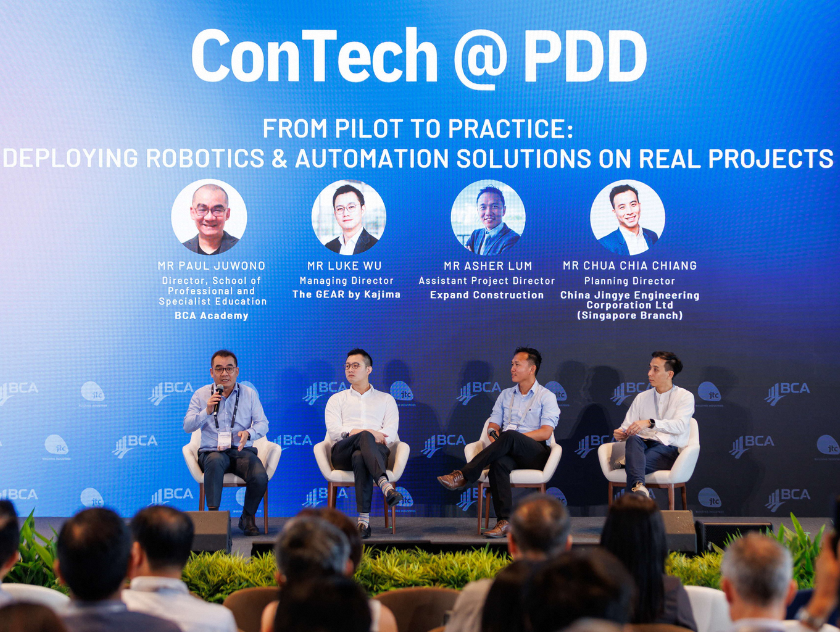
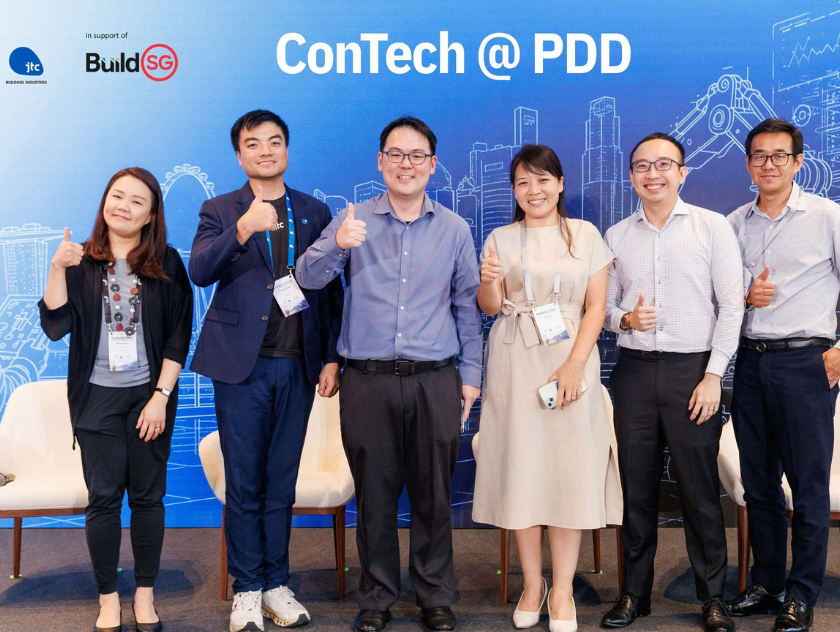
ConTech @ Punggol Digital District, co-organised with Building and Construction Authority Singapore (BCA), brought together key leaders from Singapore’s public agencies, laying out a collective roadmap for the future of the built environment. Contractors, developers, and technology vendors alike agree: Robotics and Automation (R&A) is now a necessity, actively transforming job sites with speed, efficiency, and safety.
Addressing the physical hazards of overhead drilling, Wong Kee Zhang, Application Specialist from Shiftectonics, explained how CSC Robotics units handle heavy labour while keeping workers out of danger.
"Deep hole overhead concrete drilling is very strenuous on the workers," Wong told moderator Andy Wee, General Manager of IES INCA. "Even if you can ensure that you have 100% safety for your own operations, there are other factors at play. So we thought, what if we could put a robot there so the worker is taken out of danger completely?”
Removing the physical risk does not mean eliminating human control. CSC’s D3 robots rely on AI computer vision to spot targets but also require operator confirmation to execute.
"Instead of a full automation, we're really looking at a solution where the human is always in the loop," Wong explained. "The operator should always be able to make a decision on the spot. After this executive decision is made, that's where the automation comes in. The machine takes over all the difficult work like trying to straighten the drill, actually drilling the hole, sucking the dust.”
He noted that this technology is already deployed across complex Singapore projects, including Guoco Tower, the North-South Corridor, and MRT tunnel segments, as well as internationally in Hong Kong and the UAE. "With an automated solution, the robot can also collect and utilise the data for itself for future reference," Wong added, highlighting the importance of diagnostic logging during heavy operations.
Transitioning to surface finishing, Dr Frank Mao, Founder and Managing Director of NovaBuild, explained how their robots utilise 3D scanning and Building Information Modelling (BIM) integration to train their plastering, painting, and skimming robots in digital environments before entering the site.
"We train the robots within certain digital conditions," Dr Mao explained. "The robots will automatically capture the programming file. As long as the robot enters the same room, it can do all the operations autonomously."
While the robot executes the heavy lifting, human skill remains essential for finishing work: "All the motion, quality control and time control should be done by the robot itself. But robots will never be 100% perfect, so we need a human to take care of the finishing, like the edges, corners, and the overlapping areas."
Novabuild has already completed over 160,000 square meters across 25 projects in Singapore and is continuing to expand its reach.
Streamlining finishing work even further, Keefe Wayne Teo, Co-founder and CEO of Fabrica.ai, discussed his single-button, autonomous tile-grouting robot built for easy adoption by site crews.
"What we have invented is an autonomous tile grouting robot," Teo stated. "There is no BIM model, there are no phones required, there is no need for any specialised training or any iPad. The worker just needs to mix grout, load it in the cartridge, load the cartridge into the robot, and then load water in the water tank - that's it."
Fabrica.ai’s 60-kilogram unit uses LiDAR to navigate rooms, relying on simple red tape laid across the surface area as a boundary marker.
"It's a bit like a Roomba at home... it saves your time because you can be doing something else while the robot is working, like wall grouting or cleaning up the next room in preparation for floor grouting," Teo explained.
Most importantly, the robot ensures consistent quality across every groove: "How do you know whether the worker pushes the grout across the gaps? You'll only know after a few months when the grout falls through, and there are complaints because there's a hole in the grout line. Our robot is more consistent."
To combat high initial CapEx, Teo said that Fabrica.ai adopts a specialised subcontractor model: "In order to ease the transition for robotics, if you are still scared that your workers don't know how to use the robot, what if the robot breaks down? The answer is that you just pay for the end result, that's it."
Dr Mao added that operational friction on site is often a result of coordination chokepoints rather than machine limitations: "In our experience, 80% of the problem comes from waiting and communication issues. The integration between the site and the process is just the start. We need to design a workflow process for our customers which can have very good integration and reduce the waiting time, as well as the waste of materials and manual costs."
Meanwhile, Wong stressed that seamless adoption also relies on keeping site crews engaged and satisfied: "Worker retention is very important. When it comes to a new technology like a robot, it's very costly to train these people in completely new skills... my role here is to make adoption as painless as possible."
Looking ahead, the panellists identified Singapore as a premier launchpad for global scaling. Dr Mao affirmed that "Singapore is the best place to establish a profitable business model," noting that "the robot on site itself is a data sensor, data carrier, and also a data processor. If we can use the robots on a big scale, we can reshape the whole game."
Concluding the discussion, Wong said that the industry's digital leap requires collective momentum across all trades: "Whether we succeed in this, it's not just us doing robotics. It's across the board, all of us adopting the various types of technologies in different platforms."
This piece was adapted from a panel discussion at ConTech @ PDD on 17 Jul 2026.