With the construction industry facing increasing labour constraints and project complexity, as well as tighter delivery timelines, Robotics and Automation (R&A) is becoming an operational necessity.
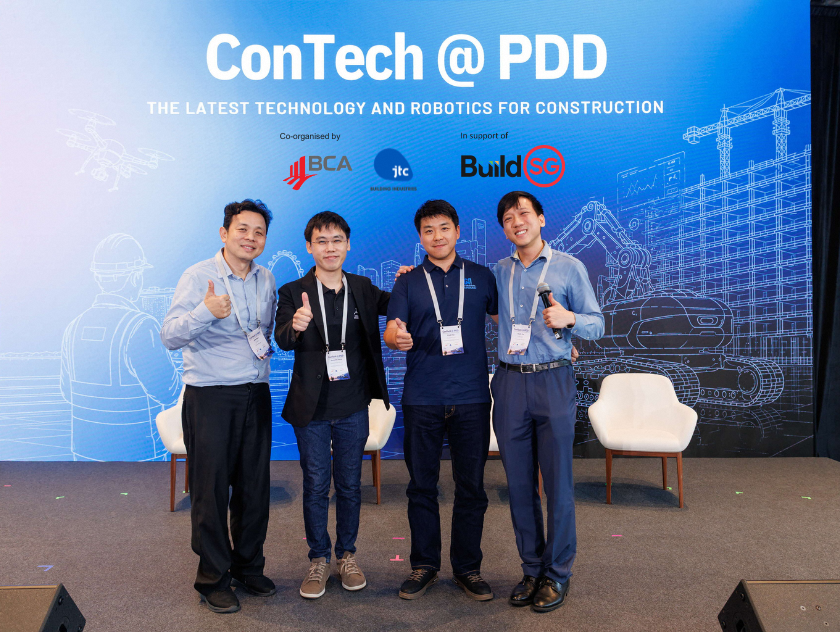
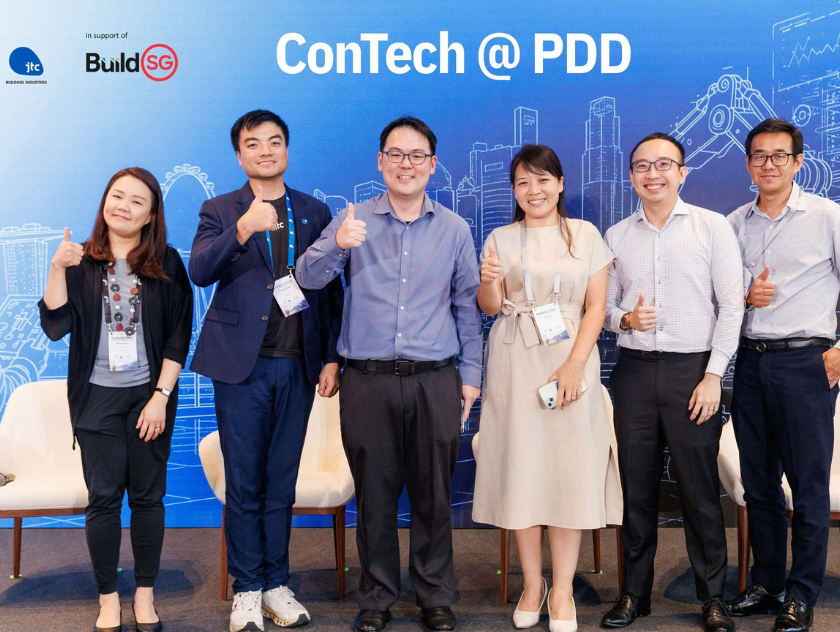
During a panel discussion at JTC and BCA’s recent ConTech @ Punggol Digital District, leading contractors and developers discussed their experiences deploying R&A on construction worksites in Singapore.
Luke Wu, Managing Director of The GEAR by Kajima, emphasised the firm’s focus on innovation directly serving site operations. "Technology that isn't used to solve real issues under real constraints and conditions is not that useful," Wu said, adding that "any solution that we develop must return to the site."
At the Autonomous Heavy Construction Equipment sandbox with JTC at the Jurong Innovation District, Kajima is testing fleet-level orchestration and excavator autonomy. Meanwhile, at the Toa Payoh Integrated Development (TPID) live project, Kajima is testing high-precision trades such as 6G welding for truss pipe joints.
Putting this technical difficulty into perspective, Wu noted, "So for all the non-welders in the audience, 6G welding is hard. If you can weld in 6G, you can probably weld anything. The joint is fixed, the angles are unforgiving, and the welder—or in our case, the robot—has to orient every single welding position in a single continuous pass." He added, "If we are successful, the use of a 6G welding robot in TPID will be a first in both Singapore and Japan."
Wu nonetheless cautioned against replacing workable equipment, stating, "As Minister Chee Hong Tat said earlier, we're not here to reinvent the wheel; we're not here to reinvent the supply chain. We don't want to replace existing inventories with new equipment."
Urging proactive adoption, Wu emphasised, "We know that the productivity crunch is going to hit, so it's better to just get ahead.”
Speaking from the main contractor's perspective on the ~$600 million NS Square project, Asher Lum, Assistant Project Director at Expand Construction, shared how technology helped navigate a complex operational environment at the land-water interface. Lum made it clear that "at NS Square, technology was never the starting point—challenges were. Like many projects in the industry now, we face more complex problems such as higher expectations, workforce constraints, and the constant pressure to deliver more with less." He explained, "That's why robotics and automation are no longer a fashionable idea; it is a strategic business imperative."
While Expand is already deploying concrete levelling, wall painting, and floor grinding robots, Lum warned, "Deploying a robot is easy—you can buy one—but once you've bought it, sustaining the deployment, or getting people to use the robot, is harder."
In terms of mindset, talent and collaboration, Lum explained, "I think first, it's top-down... What we need is to have our own mindset shift, right from top management. Then from there, to the middle management where they can start to think about the change, then the talent can come in." He emphasised that "the software helps us to see better, work better, and build better; the hardware enables us to click in, work together, collaborate better.”
Lum notes, "People should focus on higher value-added activities, not repetitive work," and asserting that "technology succeeds only when people are ready to embrace it. It should not replace people; technology should help people to focus on higher value-added activities."
Chua Chia Chiang, Planning Director at MCC Singapore, offered a candid account of how their approach evolved through trial and error at the CR101 Changi East project.
In 2024, MCC Singapore imported a fully autonomous concrete levelling robot. Chua recalled, "The pilot actually demonstrated potential but also revealed some of the limitations of autonomous construction robots," including reliance on overseas technical support, frequent software tweaks, and a scarcity of local engineers skilled in construction, programming, and robotics.
"I think we paid a very heavy price (in this scenario), thinking that autonomous robots could replace workers,” Chua acknowledged.
This prompted MCC Singapore to pivot in 2024 from fully autonomous robots to assistive robotics that keep humans in the loop. Chua noted, "These are robots made to empower workers, not robots made to replace them."
Their Aerated Lightweight Concrete (ALC) panel installation robot—a first in Singapore—handles heavy lifting in confined spaces. "With the robot taking over much of these tasks, we have significantly reduced high-risk lifting operations and also minimised human-machine interaction within confined spaces," he shared. A joint study with LTA and BCA showed a 30% improvement in manpower productivity alongside positive worker feedback.
Chua also highlighted the need to prepare site environments beforehand: "We do look into this holistically on the way we refine the construction processes so that all these designs are ready for robotic implementation." He noted that "One thing is that we have to focus on is the human aspect when we're dealing with all these technologies. Because eventually, end of the day, it's the workers or the operator who is going to use the technology," adding, "I think the only constant is change, so we have to change, or you will be outdated."
Moderator Paul Juwono, Director of the School of Professional and Specialist Education at @BCA Academy, summarised that successful adoption relies on agility and execution rather than firm size. Responding to whether large firms will outpace smaller contractors, Wu observed, "The gap will be amongst two groups: early and fast adopters vs last adopters. Big or small, disruption and innovation will come for us all."
He even suggested that smaller companies might hold a structural advantage, arguing, "Sometimes a smaller company might be more agile and hold a more advantageous position. Larger companies have to go through rounds and rounds of approvals.”
This piece was adapted from a panel discussion at ConTech @ PDD on 17 Jul 2026.