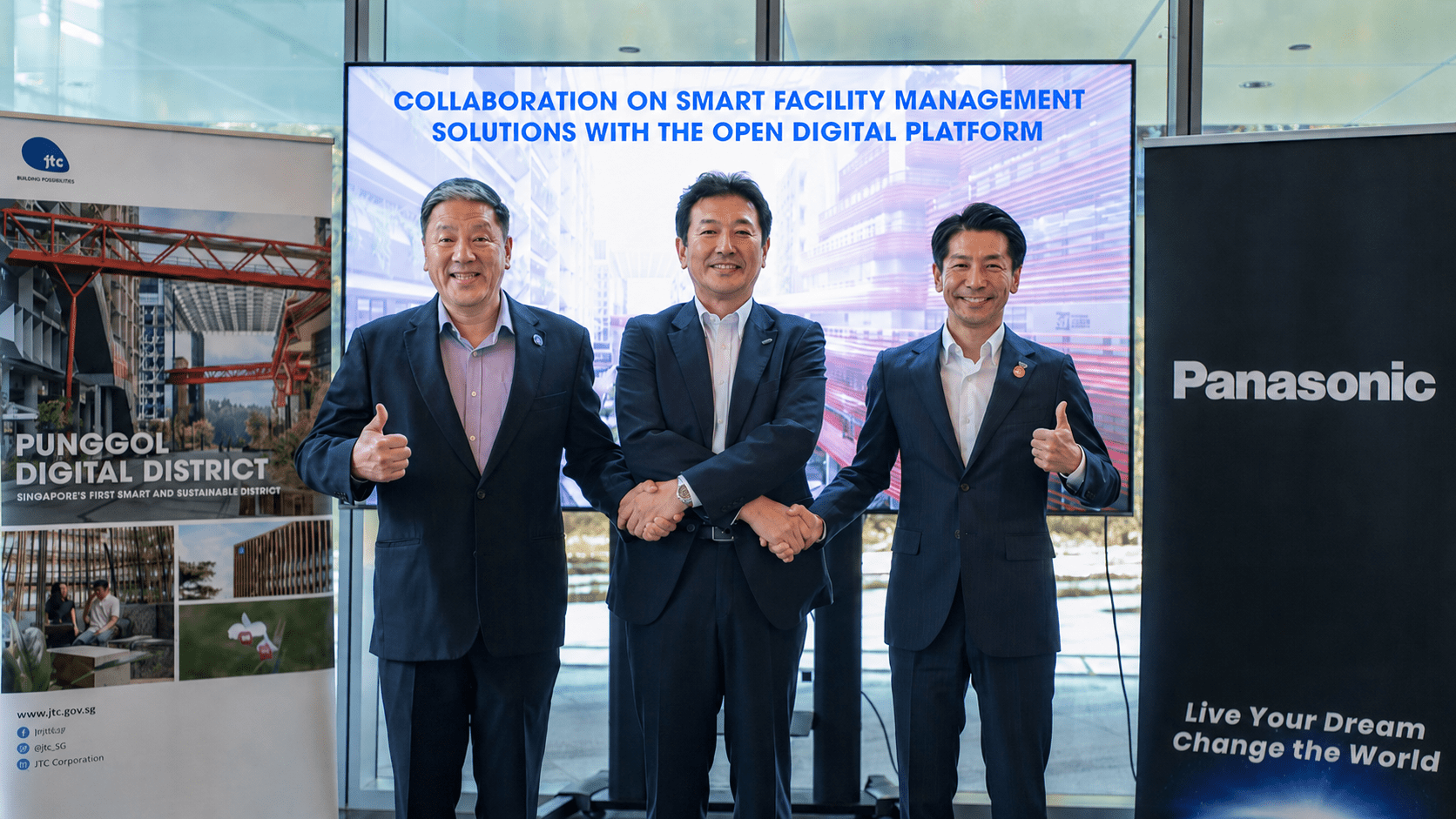
Panasonic will be the first partner to make use of the Open Digital Platform (ODP), Punggol Digital District’s (PDD) smart operating system to develop and test solutions for deployment in PDD's live urban environment.
Developed by JTC and the Government Technology Agency of Singapore, the ODP aggregates real-time data from more than 20,000 sensors throughout PDD and various systems1 into a common backend. The ODP also powers a PDD digital twin, allowing for real-time visualisation of the district, simulation of district conditions based on past data, and virtual testbedding of new technologies before they are deployed. This provides live, district-wide data to develop its solutions and historical data for training predictive models.
JTC, Panasonic Electric Works Company and Panasonic R&D Center Singapore have signed a Memorandum of Understanding (MOU) to jointly develop, deploy and validate AI-enabled smart infrastructure and facilities management solutions that support safer, more autonomous and manpower-efficient building operations in PDD using the ODP. By leveraging real-time operational data through the ODP, Panasonic aims to build solutions that enhance how facilities management teams monitor building conditions, detect abnormalities, coordinate responses and optimise resources across buildings. The parties are exploring AI-powered anomaly detection systems that identify unusual conditions and trigger coordinated automated inspection and response actions.
All data for testbedding shared with PDD tenants, such as Panasonic, is curated and anonymised. Proprietary tenant and project data are isolated for security through controlled access boundaries, governed permissions, and separate logical data zones2.
The collaboration builds on Panasonic's expertise in smart building, automation and robotics technologies. Through its Innovation Hub in PDD, Panasonic has already developed solutions such as facility automation systems and AI-enabled building inspection tools. Connecting these solutions to the ODP now allows Panasonic to deploy them in a real-world environment and validate them under actual operating conditions. Building on its experience in energy and building systems, Panasonic aims to use PDD as a real-world environment to accelerate the deployment, validation and scaling of next-generation building solutions, while generating insights that can support future implementation across Asia and other global markets.
These efforts support Panasonic Electric Works’ broader vision of smart facility management, where physical AI3, intelligent sensing and connected building systems work together to optimise energy use, enhance occupant wellbeing, augment human operators and reduce manual workload, while improving safety, reliability and service quality in complex urban environments. The company provides electrical infrastructure and building solutions that support energy management, safety, comfort and wellbeing across a wide range of built environments.
Mr Masaaki Isoda, CTO, Panasonic Electric Works Company said: "At Panasonic Electric Works, we are focused on developing practical smart building solutions that use physical AI, sensing and connected building technologies to make facility operations safer, more efficient and more resilient. Our Innovation Hub in Punggol Digital District supports this direction by providing a relevant setting to validate how these technologies can work with real operational data, workflows and partners through the Open Digital Platform. Through this collaboration, we aim to advance solutions that support smart building operations, faster decision-making and more reliable continuity of services, while building knowledge that can inform future deployment in other urban environments."
Mr David Tan, Assistant CEO, JTC, said: "The ODP connects systems and provides real-time data, empowering innovators to identify real-world challenges and use technology to solve them. Panasonic’s integration reflects industry confidence in the platform and demonstrates its value in addressing practical challenges. We welcome more companies to develop, test and deploy innovative solutions in PDD."
The collaboration adds to the growing portfolio of innovation partnerships within PDD, where companies, researchers and public sector agencies are working together to develop and deploy solutions in areas such as artificial intelligence, robotics, urban sustainability and smart infrastructure. With access to the ODP and a live operating environment, innovators in PDD test how technologies perform not only as standalone solutions in a lab, but also as part of integrated district operations with a variety of users such as workers, students, and nearby residents. This accelerates their transition from proof-of-concept to scalable deployment and commercialisation, strengthening Singapore as a hub for urban innovation.
1 District systems include the district cooling system, pneumatic waste conveyance system, and integrated building management system.
2 Separate logical data zones: Tenant and project data is kept isolated and invisible to one another through software-based controls, such as separate database schemas, virtual networks, or encryption keys, rather than physical hardware separation, preventing cross-tenant exposure even when data resides on shared servers.
3 Physical AI combines AI models, vision, sensors, and reasoning to interact with the physical world.