Key highlights from CEO Jacqueline Poh's speech at JTC Customers' Day 2026
In an era of intensifying global competition and volatility, our task is clear: to ensure that Singapore and its industries have every chance to succeed amid disruption and change.
Manufacturing powers record growth
In 2025, Singapore achieved stronger-than-expected GDP growth of 4.8%, underpinned by 8.7% year-on-year expansion in the manufacturing sector, an impressive outcome for an economy at our stage of development and services maturity. Manufacturing now contributes 20% of our GDP, reinforcing our position as a trusted and pro-enterprise hub. The Ministry of Trade and Industry projects continued growth of 2–4% in 2026, reflecting our economy’s continued resilience.
Global economic challenges create new pressures
Singapore is not immune to global headwinds. Geopolitical contestation, supply chain rebalancing, and shifting investment flows are redrawing the map of industrial competitiveness. Rising costs and manpower pressures persist while AI and robotics have yet to unlock their full productivity promise.
At JTC, we are responding decisively by strengthening our industrial infrastructure, building strategic ecosystems, streamlining our policies, and forging deep partnerships that accelerate growth.
Scaling up our industrial infrastructure
We plan, manage, and develop land and space to support various industries such as general and advanced manufacturing, logistics, and the digital economy.
We are also increasing land supply through the Industrial Government Land Sales (IGLS) programme. 10 sites totalling 291,000 sqm of GFA were awarded in 2025—double the sites and 16% more space than in 2024. Eight more sites (225,000 sqm) will be launched in H1 2026.
We are designing not just for efficiency, but for the future. Our new developments include Bedok Food City for food manufacturers, Defu Industrial City as the largest multi-user industrial complex, and Bulim Square—a Green Mark Platinum development featuring Singapore's first underground logistics network and an eventual 11-km sky corridor with dedicated paths for pedestrians and autonomous shuttles. We have also rejuvenated 500,000 sqm of space in our mature estates and will continue to do so.
Strategic ecosystems that work
Jurong Island is transforming for next-phase energy and chemicals innovation, including sustainability and decarbonisation initiatives. Data centres will be set up for the first time in Jurong Island, leveraging the island's rich power infrastructure whilst catalysing new energies and low-carbon innovation. Jurong Innovation District serves as a living lab for advanced manufacturing, research, and technology, with the 2024 Decarbonisation Living Lab innovation call awarding nearly $3 million to nine projects.
As PM Lawrence Wong announced at Budget 2026, we will establish a new AI park at One-North—dedicated spaces for companies, researchers and partners to test solutions and translate AI into real applications. More details will be revealed at the Committee of Supply in Early March.
Policies that respond
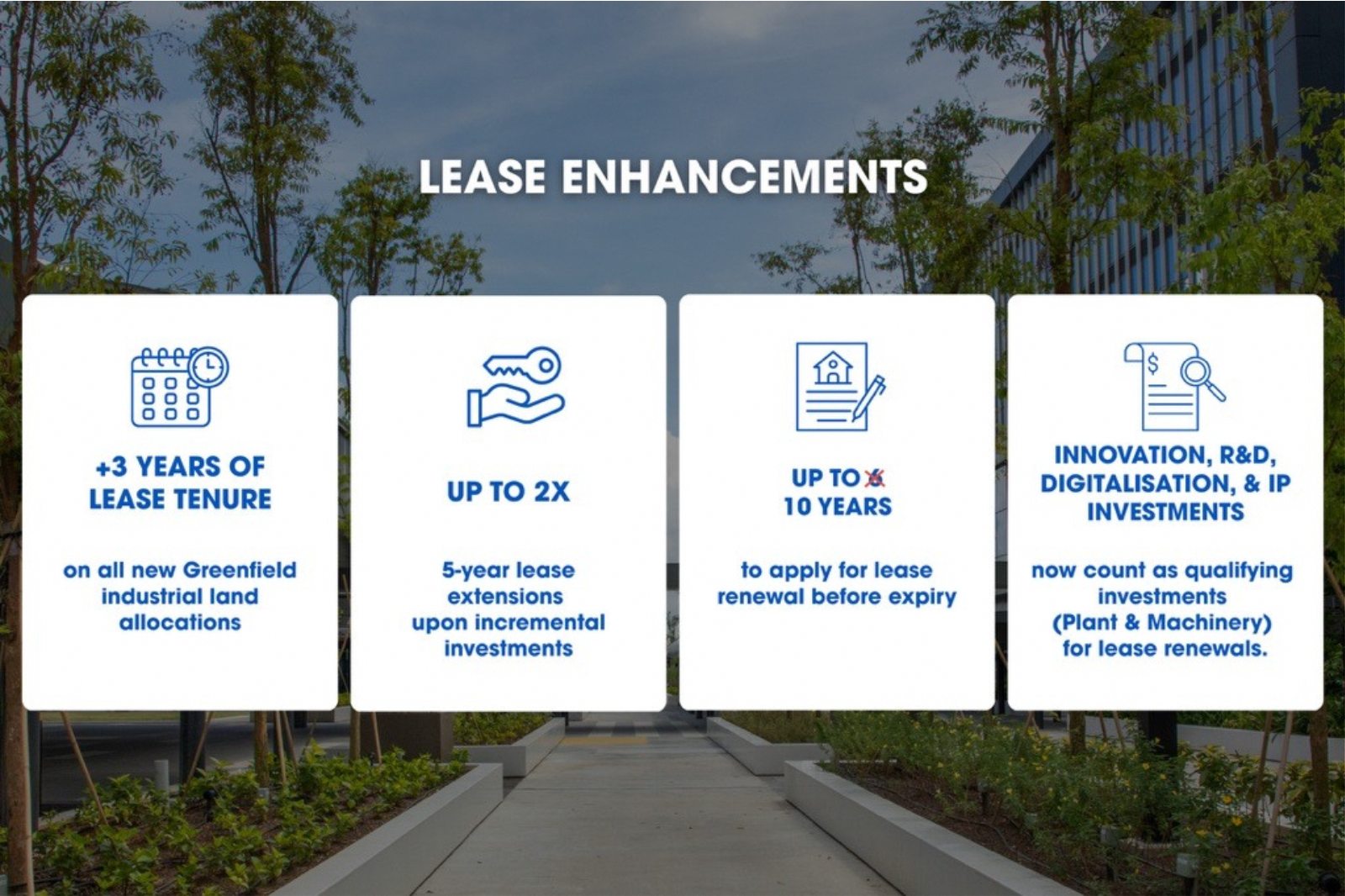
Our lease extension and renewal enhancements directly address company feedback on approval processes and lease structures.
The new Flexible Lease Extension Initiative (FLEXI) provides all new greenfield industrial land allocations with three extra years of lease tenure to cover development periods. Eligible businesses can receive up to two five-year lease extensions when making incremental investments. Companies can now apply for lease renewal up to 10 years before expiry instead of six, providing greater planning certainty. Additionally, auditable investments in innovation, R&D, digitalisation, and IP creation are now included in what we consider to be plant and machinery investments for lease renewals.
Networks that accelerate growth
Business transformation requires more than physical space—it demands strong networks and collaboration.
Through Industry Connect, JTC is linking companies with capability-building programmes, partnerships, and talent pipelines. 2 MOUs with 10 Institutes of Higher Learning and 5 Trade Associations and Chambers expand Industry Connect’s access to market insights, cross-border opportunities, and innovation ecosystems.
Key partners include the Singapore Business Federation, which has established a Centre for the Future of Trade and Investment (COFTI) to help companies internationalise, and the Singapore Manufacturing Federation, which offers guidance on accessing the Johor-Singapore Special Economic Zone.
Timely solutions for space constraints
Operators and suppliers of heavy machinery are experiencing a space crunch due to the current construction boom. In response, we are providing land allocation to Singapore Contractors Association Limited, Singapore Metal & Machinery Association, and Singapore Cranes Association. These associations will allocate space to their members, creating a more efficient distribution system that meets industry-specific needs.
Building tomorrow, today
Singapore's industrial transformation isn't just about expansion—it's about future-proofing by design. Every initiative, partnership, and policy builds our national architecture of foresight, collaboration, and trust.
As JTC, we are shaping the spaces, policies, and partnerships that let businesses thrive. Through strategic infrastructure and an unwavering commitment to partnership, we are not just preparing for the future—we are building it, together.